The Great Indian Mathematicians
Know about Indian Brains!
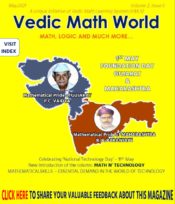


P.C. VAIDYA & EINSTEIN FIELD EQUATIONS
Published in May2021 issue of ‘VEDIC MATH WORLD’ – magazine
INTRODUCTION:
Prahalad Chunnilal Vaidya was a Gujarati PHYSICIST AND MATHEMATICIAN, whose work on general relativity is equally comparable to its innovator Albert Einstein. P C Vaidya researched a lot into the general theory of relativity. He was best known as the founder of Community Science Centre. Apart from his scientific career, he was also an educationist, freedom fighter, and a follower of Gandhian philosophy in post-independence India, in Gujarat.
Birth Anniversary : 23rd May, 1918
Birth Place : Junagadh (Gujarat)
Death Anniversary : 12th March, 2010
Famous Works : Vaidya Metric | Vaidya–Patel solution | Einstein field equations
EDUCATION & CAREER:
He was Born on 23 May 1918. 2021 year marks his 103rd birth anniversary. P. C. Vaidya was born in a village called Shahpur of Junagadh district, Gujarat, India. In 1931, his father passed away when he was in 9th standard only. He finished his most of his schooling in Bhavnagar and went to Mumbai for higher studies. There, after he completed his high school at Ismail Yusuf College, he joined the Institute of Science in Mumbai. From starting He had shown a special aptitude for being a mathematician. He completed his B.Sc. (Mathematics) with Physics. He also completed his MSc degree in applied mathematics.
After accomplished M.sc Examinations. In 1940 he started as a lecturer at Dharmendra Singhji college in Rajkot. There he used to teach arithmetic and trigonometry to undergraduate students. He was a faithful believer of Ahinsa, honesty, and simplicity. he plays part in the freedom movement, but in a different way. In 1941 he resigned from lectureship and founded Ahinsak Vyayam Sangh institute of physical education for training youths for non-violent struggle with freedom fighter Prithvi Singh Azad. . He was the Principal of AVS. At that time too, he continued teaching mathematics by conducting private tuition for school students.
In 1942, P. C. Vaidya wrote a letter to Professor Vishnu Vasudev Narlikar, father of Indian physicist Jayant Narlikar, expressing his aspiration to study relativity. Narlikar approved this, and Vaidya immediately shifted to Banaras Hindu University(BHU), Varanasi, where Narlikar was a faculty member at the school of relativity. He spent around 10 months at Banaras. in 1949 Professor Vaidya obtained his Doctoral degree (PhD) in mathematics.
VAIDYA METRIC & EINSTEIN FIELD EQUATIONS
In the year 1942, Vaidya went to Banaras Hindu University he researched Albert Einstein’s theory of gravity equations which is described by a set of equations that use the mathematics of Riemannian geometry.
P.C. Vaidya took up solution inventing work which led to the conception of such a solution that is known as the Vaidya metric. the revolutionary idea of developing a spacetime geometry was delivered by him, which would describe the gravitational potentials in the exterior of a radiating star. This is may be used to model astrophysical stars. Vaidya metric narrates the non-empty external spacetime of a nonrotating star which is spherically symmetric and either emitting or absorbing null dust. Vaidya is known to be one of the forerunners of the Golden age of general relativity. There was inventing work done around the same area, but it was helpful up to some extent. The distinguished Schwarzschild Solution describes the geometry around a spherical star. However, it is necessarily accepting the exterior of the star to be empty. Vaidya generalized this case to incorporate the radiation from the star, and the resulting solution was the famous Vaidya metric. His discovery of the Vaidya Metric gave him a Globally recognition at the age of 24, even before the beginning of his professional career.
CONTRIBUTION IN MATHEMATICS:
P.C Vaidya became a professor at Gujarat college in the year of 1955. Within three years, he appointed as principal of M. N. College, Visnagar by the Director of Education. After a year he associates with the newly set up department of Mathematics at Gujarat University. Because of his great leadership quality, he got the position of Vice-Chancellor. His primary attention was always on mathematics education. Gujarat Ganit Mandal, the Mathematical Society of Gujarat was commenced by Vaidya in 1963. The first conference of the most dynamic mathematical society of India was held in Bhavnagar in 1960. In 1963, Vikram Sarabhai met Vaidya to discuss how they can make Mathematics and Science more popular; this meeting leads the way to the establishment of the Community Science Centre in Ahmedabad. Between 1964 and 1973, he served as a Visiting Professor of Mathematics at Washington State University, USA; London University, York University, and Newcastle University in the UK. He also addressed the 6th International Conference on General Relativity and Gravitation at Copenhagen. During the later stages of his life, Shri. Vaidya had confined himself to his Ahmedabad house due to poor health. He passed away on 12 March 2010. With this background understanding of Vaidya to create awareness among the new generation of science enthusiasts, the bibliometric study was undertaken. Major contributions Vaidya has done in the literature of physics and mathematics. Apart from all these, he has a numerus publication on his various works. Further details about his publications are mentioned below.
VARIOUS BOOKS/MAGAZINE PUBLICATION OF SHRI P. C. VAIDYA:
‘suganitam’ – a mathamematics magazine
Various articles in ‘kumar’ gujarti cultural magazine
Various popular science books majority in Gujarati language
‘Ganit Darshan’ – English translation: Discourses in Mathematics
‘Dashansh Paddhati Sha Mate?’ – English translation: Why Decimal System?
‘Dadaji Ni Vato’ – English translation: Grandpa’s Tales
‘Akhil Brahamandman’ – English translation: In the Entire Universe
‘What is Modern Mathematics?’ – It was in English language, originally.
THE GREAT INDIAN MATHEMATICIAN – BRAHMGUPTA
WHO TAUGHT THE WORLD THE USAGE OF ‘ZERO’
Published in April2021 issue of ‘VEDIC MATH WORLD’ – magazine
INTRODUCTION:
Brahmagupta was born at the end of the sixth century (598 AD) in Bhillamala in capital of Gujaratdesa – the second largest Kingdome of western India. During Medieval India, it was a major centre of learning mathematics and astronomy. Medieval India refers to a quite a lot long period of the history of the Indian subcontinent which connects the “ancient period” and “modern period”. It encompasses the 6th to the 16th centuries. Today, it is known as Bhinmal in Rajasthan. ‘Brahmagupta’ was the son of Jishnugupta and was a Hindu by religion. He was follower of Lord Shiva. Brahmagupta became an astronomer of the Brahmapaksha school, one of the four major schools of Indian astronomy during that period. He studied the five traditional Siddhanta on Indian astronomy as well as the work of other astronomers including Aryabhata I, Latadeva, Pradyumna, Varahamihira, Simha, Srisena, Vijayanandin and Vishnuchandra. Rules of computations with zero was given by none other than – the great Indian mathematician ‘Brahmagupta’.
WHAT ZERO WAS CALLED?
Brahmagupta wrote a book named ‘Brahma-sphut-sidhdhanta’ which covered many rules and understanding about number system. He defined the operations of zero and made the world learn the usage of zero. He defined Positive numbers as ‘Dhana’ (धन) which are presently known as ‘fortunes’. He defined Negative numbers as ‘Runa’(ऋण) which are presently known as ‘debts’. ‘Zero’ or ‘Nothing’ was known as ‘Kha’(ख).
BRAHMA-SPHUTA-SIDDHANTA
He wrote Brahma-sphuta-siddhanta in the year 628AD at the age of 30. Brahma-sphuta-siddhant means correctly established doctrine of Brahma. It combines existing knowledge of Astronomy and Maths with lot of new and original material added by Brahmgupta. It is written in Sanskrit in specific type of verse known as ‘Arya meter’. It contains some remarkably advanced idea including a good understanding of the mathematical role of zero, rules for manipulating both positive and negative numbers, a method for computing square roots, method for solving some linear and quadratic equation and rules for finding the sum of series.
he Brahma-sphuta-siddhanta contains twenty-five chapters. The first ten chapters are the first version of Brahmagupta’s work. These ten chapters are arranged in topics which are typical of Indian mathematical astronomy texts of the period. The topics covered are as follows:
- mean longitudes of the planets
- true longitudes of the planets
- the three problems of diurnal rotation
- lunar eclipses
- solar eclipses
- risings and settings
- the moon’s crescent
- the moon’s shadow
- conjunctions of the planets with each other
- conjunctions of the planets with the fixed stars etc…
The remaining fifteen chapters seem to form a second part of his work which is an important addition to the original treatise. These chapters cover the topics as follows:
- examination of previous treatises on astronomy on mathematics
- algebra
- gnomon
- meters
- Sphere etc…
Brahmagupta’s understanding of the number systems went far beyond that of others of the period. Its difficult for us to imagine what novel and strange concept zero was when it is first introduced in mathematical scene. Zero has been use as a placeholder in positional number system for a very long time but what Brahmagupta did was introduced zero as a number in itself. He laid down various rules for doing arithmetic with zero and with negative numbers another innovation at the time. he defined zero as the result of subtracting a number from itself.
In the Brahma-sphuta-siddhanta he defined zero as the result of subtracting a number from itself. He gave some properties as follows:
- The addition and subtraction operation of numbers with Zero was defined by him as follows: When zero is added to a number or subtracted from a number, the number remains unchanged.
- He defined, when a number is multiplied with zero, it becomes zero.
- He also gave arithmetical rules. The word ‘fortunes’(धन) and ‘debts’(ऋण) defined by him as ‘positive numbers’ and ‘negative numbers’ respectively. The definition given by him was as follows:
- A debt minus zero is a debt.
- A fortune minus zero is a fortune.
- Zero minus zero is a zero.
- A debt subtracted from zero is a fortune.
- A fortune subtracted from zero is a debt.
- The product of zero multiplied by a debt or fortune is zero.
- The product of zero multiplied by zero is zero.
- The product or quotient of two fortunes is one fortune.
- The product or quotient of two debts is one fortune.
- The product or quotient of a debt and a fortune is a debt.
- The product or quotient of a fortune and a debt is a debt.
Brahmagupta then tried to extend arithmetic operation including the division by zero.
- Positive or negative numbers when divided by zero results into a fraction that contains zero as denominator.
- Zero divided by either negative or positive numbers results into either zero or is expressed as a fraction with zero as numerator and finite quantity by denominator.
- Zero divided by zero is zero. Please note that when ‘Brahmagupta’ quoted that, zero divided by zero is zero. Today, we know dividing zero by zero is an undefined phenomenon. He was certainly wrong about it. But it was really an extremely intellectual attempt to extend arithmetic to negative numbers and zero during medieval India.
CONCLUSION:
Brahmagupta was one of the key mathematicians in the world because he invented the idea of ‘zero’ or ‘nothing’. His work gave the world the proper guidelines in knowing effective usage of ‘zero’. He quite gracefully gave many correct usages of zero during medieval times of India.
ACHARYA PINGALA – THE FATHER OF BINARY NUMBER SYSTEM (300BCE)
Interesting History of Binary Number system by an Indian Mathematician
Published in March2021 issue of ‘VEDIC MATH WORLD’ – magazine
INTRODUCTION:
We all do card magic tricks and try to entertain people, bringing their attention towards us. But do you know how this magic tricks actually works. Some people may know, some are unaware to this, So Let me tell you, this magic trick applies binary number system.
Do you know? Ancient Indian’s were the earliest to discover the binary number system.
HISTORY BEHIND BINARY NUMBERS
Let’s reveal the historical story behind the Binary Number System. In Ancient India there was a mathematician named, ARCHARAYA PINGALA who had discovered the immense possibility of binary number system. So, let us read about this interesting mathematician, and about his discovery.
WHO IS ACHARYA PINGALA?
Pingala was an ancient Indian poet and an accidental mathematician who lived around 300 BCE. Few things are disclosed about Acharya Pingala. He was the writer of Chandahsastra, in which he interpreted Sanskrit poetry mathematically. It also stated the first known explanation of Binary number, Fibonacci numbers and Pascal’s Triangle.
WHAT IS CHANDAHSHASTRA?
It means the science of meters used in the poetries for recitation. While studying this, Acharya Pingala discovered the concept of binary number system.
SO HOW ARCHARYA PINGALA DISCOVERED THE BINARY NUMBER SYSTEM?
Archaraya Pingala worked on ‘Chandah’ which refers to one of the six Vedanga. ‘Vedangas’ are know as the arms of Vedic studies.
In Sanskrit Prosody or ‘Chandah’ , there are ‘Dheerga swar’ or Long pronunciation and the ‘Laghu swar’ or short pronunciation.
The combination of long and short swar is the basis of Sanskrit prosody or ‘Chandah’.
Science of meters is explained in a musical way in Chandah Prosody.
So, While studying Chandah, Archaraya Pingala came across the concept of Binary number system.
In Chandahsastra, the first known description of abinary numeral system shows connection of the systematic enumeration of meters with fixed patterns of short and long syllables.
The Chandahsastra or the study of composing poetry based on two kinds of syllables:
Binary numeral system
Combinatorics of meter corresponds to the binomial theorem
Pingala could explain the concept of binary numbers bit he was unaware about the usage of zero that time, so he used light (laghu) and heavy (guru) rather than00 and 11 to describe syllables.
Acharya Pingala discovered the different patterns of Binary numbers and a notation similar to Morse code.
Binary numbers uses 0 and 1, so sometimes use of zero is ascribed to Pingala due binary numbers. Pingala used Laghu (light) and Guru (heavy) rather than 0 or 1 to describe syllables. In a Classical Sanskrit Literature there is a verse, this verse determines the arrangement of long and short swars. Dheergha is the last syllable in meter. So let us refer to the long/ dheergha swara as Guru.
AN EXAMPLE OF THE COMPOSITION BY ADI SHAKARACHARYA
A very famous stranza of ‘Bhavani Ashtakam’ composed by Adi Shankaracharya is as follows,
न तातो न माता न बन्धुर्न दाता
न पुत्रो न पुत्री न भृत्यो न भर्ता ।
न जाया न विद्या न वृत्तिर्ममैव
गतिस्त्वं गतिस्त्वं त्वमेका भवानि ॥१॥
In the above stranza, there are 12 letters in each quarter. These letters are arranged in a pattern such that it has, Laghu + Guru + Guru format of the pronunciation. And this pattern is followed through out. This meter is called ‘Bhujangaprayatam’.
As 212=4096, so total 4096 arrangements can be calculated with just 2 types of swars i.e., ‘laghu’ and ‘guru’ and total 12 letters. This concludes that one can arrange letters in 4096 ways to create a stanza. Pingala introduced a technique of Pratyay (algorithm), Prastaar for all possible combinations of a syllable for a quarter with “n” letters.
A WOMAN MATHEMATICIAN WHO CONTRIBUTED IN EXPLORING GEOMETRY OF ANCIANT INDIA: T. A. SARASVATI AMMA (26 December 1918 – 15 August 2000)
Published in Fabruary2021 issue of ‘VEDIC MATH WORLD’ – magazine
She was an Indian woman scholar from Kerala. She has contributed to the fields of history of Mathematics and Sanskrit, through her work onGeometry of ancient and medieval India, which established a firm foundation for the study of Indian geometry. In this book, she has undergone a survey of the Sanskrit and Prakrt scientific and quasi-scientific literature of India. She has emphasized on theVedic literature and also brings Sulba-Sutras and mathematical parts of Jaina Canonical works in light.
In her master-piece, she mentioned the following:
Hindu Siddhantas and with the contributions to geometry
Works of the great Indian mathematicians like,
Aryabhata I & II,
Sripati,
Bhaskara I & II,
Sangamagrama Madhava,
Paramesvara,
Nilakantha
The works of the mathematicians Mahavira, Sridhara and Narayana Pandita and the Bakshali Manuscript have also been studied. The work seeks to explode the theory that the Indian mathematical genius was predominantly algebraic and computational. Her works provided proofs and rationales.
D. R. KAPREKAR AND RECREATIONAL MATH IN INDIA
Published in January2021 issue of ‘VEDIC MATH WORLD’ – magazine
What is Recreational Mathematics?
Recreational mathematics is a branch of mathematics developed for entertainment. It involves mathematical puzzles and games, often appealing to children and untrained adults, inspiring their further study of the subject.
Who is the father of Recreational Mathematics?
A US based author, Martin Gardner influenced readers all over the world with his ‘Mathematical Games’ column in Scientific American for 25 years. His work was first published in 1956.
A Famous Indian Recreational Mathematician
D.R. Kaprekar was a school-teacher in Nasik(Maharashtra) by profession. You would be amazed to know he was not having any formal post graduate training, but he worked extensively in the field of recreational mathematics and he published a lot of his researches which made him quite well-known in recreational mathematics circles. In this Issue, we are paying the tribute to this extra ordinary Math-Teacher of India, who became the recipient of numerous awards at national and international level, on his birth-anniversary (January17). Kaprekar started exercising and teaching recreational mathematics to kids and doing research in 1949. If you notice, that was quite before the work of Martin Gardner. But, it was not noticed till 1975.
Some of the extremely brilliant Works of D. R. Kaprekar:
Demlo numbers
Harshad numbers
Devlali numbers
Kaprekar’s constant
Kaprekar’s number
How respected Indian Recreational Mathematician, D. R. Kaprekar, got fame worldwide?
D.R. Kaprekar could discover a number of results in number theory. He described various properties of numbers. . He also constructed certain types of magic squares related to the Copernicus magic square. Indian mathematicians didn’t take his work seriously. His results and observations were published mostly in low-level mathematics journals. Some of his observations and discoveries were published in private journals too. But in 1975, international fame Martin Gardner wrote about Kaprekar in his column named, ‘Mathematical Games’ for Scientific American. Then, D. R. Kaprekar was a fame world-wide. Today his name is well-known and many other mathematicians have pursued the study of the properties he discovered. The only question can be raised in any true Indian mind is, why do we need an international certificate to trust our own talent? Why can’t we take the innovation work of Indians seriously without getting a yes node from the western countries?
Awards won by D. R. Kaprekar:
Kaprekar won numerous awards. The most recognized award won by him was the Wrangler R P Paranjpe Mathematical Prize in 1927.
WHY DECEMBER 22 IS CELEBRATED AS NATIONAL MATHEMATICS DAY?
Published in December2021 issue of ‘VEDIC MATH WORLD’ – magazine
INTRODUCTION:
India has given several great mathematicians since ancient era till modern era. Aryabhatta, Brahmagupta, Bhaskaracharya, Shridhara et al like great brains of the ancient times to Prasanta Chandra Mahalanobis, D. R. Kaprekar, Harshvardhan, Srinivasa Ramanujan et al great mathematicians of the modern times, have astonished the entire world with their mathematical capabilities. From concept of 0(zero) to concept of infinity with many other important innovations of mathematics are given to the world by these great mathematicians of India. They have proved that mathematics is essence of life. May it be astrology to astronomy, or particle to universe, math is around us!
NATIONAL MATHEMATICS DAY:
In 2012, the government of India declared 22nd December as national mathematics day. This Very day is the birth anniversary of the great mathematician of India – revered Srinivasan Ramanujan. The aim behind the celebration of ‘National Mathematics Day’, is to create awareness among people about the importance of mathematics for the development of humanity. Many initiatives are taken which can motivate the younger generation of the country with a positive attitude towards learning mathematics. A lot many training programmes for teachers, students and entire education fraternity are also conducted on this day which can motivate the generation of interest for Mathematics and research in related areas. On 22nd December, our nation celebrates S. Ramanujan’s birth anniversary as ‘National Mathematics Day’. It is also very interesting to know the reasons behind celebrating ‘National Mathematics Day’ on December 22. For this, we have to take a dive into the life of the great mathematician of India.
LIFE STORY OF S. RAMANUJAN:
He was born in Tamil Nadu Brahmin family in madras. His family was very poor. From his childhood life was very hard. Although the conditions were not favourable, he managed to join school. In school he didn’t find any subject interesting than mathematics and was very clever in mathematics since early age only. At the age of 12, he could excel in the concepts of trigonometry and developed many theorems by himself. After completing school education, due to his interest in mathematics, he took a job as a clerk at Indian mathematical society. Here, he started researching the deeper in the field.
He started to write letters to GH hardy with an aim of getting more knowledge in the field of mathematics. Hardy was a famous mathematician from England. At first, Hardy didn’t consider his letters but very soon he realized that he was someone unusual and unconventional. Hardy was impressed by Ramanujan and was willing to meet him at the earliest. He also helped Ramanujan to reach London. In 1914, Ramanujan reached there, where Hardy managed his stay and food as well. He was awarded a bachelor degree of science there. During his graduation, he started work with Hardy. Working together Ramanujan and Hardy, researched the thousands of theorems and research papers in mathematics. He became one of the youngest fellows of the royal society, and the first Indian to become fellow of Trinity college, Cambridge in 1918. And yes! It is not a small thing.
RAMANUJAN’S BELIEF
Ramanujan was from poor Brahmin family. He couldn’t have extremely strong background of schooling even, still he mastered the subject so strong! Whenever he was asked about it, his reply generally was, “An equation for me has no meaning, unless it represents a thought of God”. And, these lines were not just for sake, he truly believed in these. He always credited his work to visions provided to him from the goddess – Mahalakshmi. This legendary mathematician has credited his 3900 formulae to visions from Goddess Mahalakshmi happily. This way, he proved himself quite a lot humble to the entire world. His focus was always on good work and not on any kind of credits associated with the same.
RAMANUJAN’S DETERMINATION AND LOVE FOR HIS OWN CULTURE
He loved working in England. But, he was a staunch follower of Indian Braminic way of food. He didn’t ever compromise on vegetarian intake of food, which was very troublesome for him to get such a food there in England, then. When his health started falling down and he was detected with tuberculosis at higher stage, he decided to return back to India. Even After Returning India, he could not recover from his ill health he passed away in 1920.
RAMANUJAN’S CONTRIBUTION IN THE FIELD OF MATHEMATICS
In very short span of life of just 32 year, he had explored many great mathematical researches like ‘constant mock theta functions’, ‘Riemann Zeta function Ramanujan prime’, ‘Ramanujan master theorem’, ‘Ramanujan saato theory’, ‘partition of number’, ‘Ramanujan congruences’, ‘divergent series’, ‘elliptic function’, ‘continued fraction’, ‘cubic equations’, ‘quadratic equations’ et al. He submitted around 3900 formulae and numerous research papers. He solved many mathematical problems which where unsolvable till then, which definitely opened a new door for the mathematical world.
CONCLUSION
His contribution in mathematics is exceptional. He was fearless to give any of his theories about math, which were unconventional then. He never ever lost Indian touch from his personality in spite of staying in foreign for a very long period of time. He always kept his Indian believes quite strong and kept his love for Indian culture always alive in his heart. He made the name of India famous in the field of mathematics in the entire world by his tremendous work. Even after the century of his death, people are still using his great theorems as a part of their studies and research. From a poor child to great mathematician, his journey was inspirational. His contribution and hard-work shall always inspire the love for mathematics in all of us. It is believed that, his exceptional work has given a new direction to the modern mathematics. So, Indian government decided to celebrate ‘National Mathematics Day’ on his birthdate 22nd December every year as a tribute to this great Indian Mathematician. This year we are about to celebrate his 133rd birth-anniversary. Let’s together celebrate this math festival and pay the fervent homage to our great mathematician, Srinivasan Ramanujan – A Man who knew the Infinity!
FATHER OF INDIAN STATISTICS – PRASANTA CHANDRA MAHALANOBIS:
Published in November2021 issue of ‘VEDIC MATH WORLD’ – magazine
- Professor Mahalanobis is a renowned Indian scientist and applied statistician who founded the Indian Statistical Institute and devised the Mahalanobis distance, a statistical measure.
- He is also known for his key role in formulating India’s strategy for industrialization in the Second Five-Year Plan (1956-61).
- Birth Date : 29 June 1893
- Birth Place : Calcutta, Bengal
- He was the eldest of the six children of Probodh Chandra and Nirodbashini. His family was a relatively wealthy and influential one.
- He is best remembered for the “Mahalanobis distance”, astatistical measure & for being one of the members of the first Planning Commission of free
- He founded the Indian Statistical Institute and played a key role in formulating India’s strategy for industrialization in the Second Five-Year Plan (1956–61).
- He was the pioneer of the studies in “anthropometry” in India
- After completing his schooling, he went to study at the Presidency College, Calcutta where he was taught by the likes of Jagadish Chandra Bose, Sarada Prasanna Das, and Prafulla Chandra Ray.
- He moved to England to further his education at the King’s College, Cambridge. There he met the eminent Indian mathematical genius Srinivasa Ramanujan and was deeply influenced by him.
- While in England, Mahalanobis developed an interest in statistics and was fascinated by the idea of how statistics could be used to understand problems in meteorology and anthropology.
- After returning to India, he teamed up with a group of like-minded colleagues to form the Indian Statistical Institute (ISI).
- As a statistician he made several remarkable contributions to the field, and was instrumental in formulating newly independent India’s strategy for industrialization.
- He is known as the ‘Father of The Indian Statistics’.
- Awards/ Honours received by P.C. Mahalanobis:
- Weldon Memorial Prize from the University of Oxford in 1944.
- An Honorary Fellow of the Royal Statistical Society, UK, in 1954
- An Honorary Fellow of King’s College, Cambridge in 1959.
- He was honored with two prestigious awards in recognition of his contributions to statistics.:
- Padma Vibhushan
- Srinivasa Ramanujam Gold Medal
- Millions of people from the entire world pay a great respect to this great mathematician of India.
NINE MUST- KNOW FACTS ABOUT C.S. SESHADRI – AN ‘AN IRREPLACEABLE INDIAN ASSET’!
Mrs. Milli Singh (Campus Director, AVV English Medium School)
Published in October2021 issue of ‘VEDIC MATH WORLD’ – magazine
India has a remarkable history of building countless Great Indian Mathematicians, since ancient times. India always played an eminent role in the field of Mathematics and has major contribution in bagged at its name. C. S. Sheshadri is an Indian Gem from the field of Mathematics.
INTRODUCTION _ C.S. SESHADRI:
Full Name : Conjeevaram Srirangachari Seshadri
Birth Year : 1932
Birth Place : Kanchipuram, Tamil Nadu, India
Birth anniversary : 29 February
Death anniversary : 17 July 2020
Known for : algebraic geometry
Famous work of him : Seshadri constant
Narasimhan–Seshadri theorem
Standard monomial theory
Books by him : Introduction to the Theory of Standard Monomials
Geometry of G/P
Schubert Varieties
C.S. Seshadri, one of India’s most prominent mathematicians, went to eternal rest on July 17, at the age of 88. He was the eldest of eleven children and was born on 29 February 1932 in Kanchipuram, He received his B.A. (Hons) degree in Mathematics from Madras University in 1953 and was taught by Fr. Racine and S. Naryanan there. He completed his PhD from Bombay university in 1958.
His main contributions are in algebraic geometry. Other than with his contributions in geometry he also invented the Seshadri constant and the Narasimhan–Seshadri constant. Seshadri’s deep insights and remarkable accomplishments have greatly played a major role in shaping India as a major centre for mathematics in the post-independence era, particularly in the field of algebraic geometry. His work in establishing the Chennai Mathematical Institute (CMI), literally from its inception, is as noteworthy as his scientific pursuits. Today, we can say with pride that, CMI is rated as one of the best schools in the world for undergraduate studies in Mathematics and theoretical computer science.
NINE MUST-KNOW FACTS ABOUT THIS EMINENT INDIAN MATHEMATICIAN
FACT#1: C.S. SESHADRI was elected Fellow of the Indian Academy of Sciences in 1971.
FACT#2: According to Prof Mahan, he was one of the most lovably fuzzy people ever possible. While conversation it used to seem that he hardly focused on the conversation but, whenever Prof Mahan focused mathematics while conversating, he would become calm and silent and completely different person. He would absorb the problems and then explain it better Prof Mahan had ever seen anyone doing that.
FACT#3: He was elected Fellow of the Royal Society (UK) in 1988 and a Foreign Associate of the National Academy of Sciences, USA in 2010.
FACT#4: He was conferred with the Padma Bhushan in 2009.
FACT#5: At a CMI convocation, when Infosys founder Narayana Murthy was speaking, largely on human values, Seshadri walked up to Murthy and said (into the microphone), “Can you talk about all that you have done and the opportunities in quantum computing?” Talking about the incident, Narayanan said, “When an idea strikes him (Seshadri), he forgets himself.”
FACT#6: In mathematics Seshadri was riveted to algebraic geometry and algebraic groups and worked to broaden the scope of the subject and also introduced in the practice of researchers teaching undergraduate students in the country, back in the 80s.
FACT#7: He was active in his last days too. During the lockdown days also, he used to often discuss plans for the future and was worried about the need to increase the scope of the math-education.
FACT#8: He was suffering from Parkinson’s disease. He passed away due to the cardiac arrest.
FACT#9: Seshadri was a Carnatic singer who would take out time from all the mathematics for his sadhana religiously. Even in his last days, he was engaged towards doing something hence was busy with training of a music student.
Seshadri touched the lives of all by his work and modesty. He passed away recently, on 17th July, 2020. India has lost a gem. We can truly say – he was an ‘An irreplaceable Indian Asset’!
THE GREAT INDIAN MATH TEACHER – D R KAPREKAR (TEACHER’S DAY SPECIAL)
Published in September2021 issue of ‘VEDIC MATH WORLD’ – magazine
Introduction:
D. R. Kaprekarwas a school-teacher in Nasik(Maharashtra) by profession. You would be amazed to know he was not having any formal post graduate training, but he worked extensively in the field of recreational mathematics and he published a lot of his researches which made him quite well-known in recreational mathematics circles. In this, ‘Teacher’s Day’ Special Issue, we are paying the tribute to this extra ordinary Math-Teacher of India, who became the recipient of numerous awards at national and international level.
Full Name : Dattatreya Ramchandra Kaprekar
Birth Year : 1905
Birth Place : Dahanu, Maharashtra, India
Birth anniversary : 17th January
Info related to Death : 1986 (aged80–81) at Devlali, Maharashtra
Known for : recreational mathematics
Famous discovery : Kaprekar’s constant
Known as : ‘Ganitanand’
What is recreational Mathematics?
Recreational mathematics is mathematics developed for entertainment. It involves mathematical puzzles and games, often appealing to children and untrained adults, inspiring their further study of the subject.
Famous Works of D. R. Kaprekar:
Demlo number
Kaprekar also studied the Demlo numbers. He got an idea of studying these numbers at a train station 30 miles from Bombay on the then Great Indian Peninsula Railway, and studied them. The concept of “Demlo numbers” numbers is very interesting, which we have covered in ‘POWER OF VEDIC MATH SECTION’.
Demlo numbers are 1, 121, 12321, …
These numbers are the squares of 1, 11, 111 … respectively.
For more details, you can take reference of the below examples.
(1)2 = 1 (11)2 = 121
(111)2 = 12321 (1111)2 = 1234321
(11111)2 = 123454321 (111111)2 = 12345654321
Kaprekar’s constant:
D. R. Kaprekar worked on a number 6174 and dig out an interesting property of the same number. Let’s understand the property by examples. 6174 is known asKaprekar’s constant.
How to get the Kaprekar’s Constant?
Step1 : Take any four-digit number, using at least two different digits (leading zeros are allowed).
Step 2 : Arrange the digits in descending and then in ascending order to get two four-digit numbers, adding leading zeros if necessary.
Step 3 : Subtract the smaller number from the bigger number.
Step 4 : Go back to step 2 and repeat.
Example:
Step1 : Selected four digit number is, 6742.
Step 2 : digits arranged in an ascending order = 7642
digits arranged in an descending order = 2467
Step 3 : 7642 – 2467 = 5175
Step 4 : Repeat the process for 5175
digits arranged in an ascending order = 7551
digits arranged in an descending order = 1557
7551 – 1557 = 5994
Repeat the process for 5994
digits arranged in an ascending order = 9954
digits arranged in an descending order = 4599
9954 – 4599 = 5355
Repeat the process further,
5553 – 3555 = 1998
9981 – 1899 = 8082
8820 – 0288 = 8532
8532 – 2358 = 6174 ( Kaprekar’s Constant)
Harshad Number
In Sanskrit, ‘Harsha’ means ‘Joy’. ‘Harshad’ means ‘The one who gives joy’.
Definition of the ‘Harshad Number’: They are divisible by the sum of the digits of the given number.
Example:
Let’s say, the chosen number is ‘24’.
Sum of the digits of 24 = 2 + 4 = 6
24 is divisible by 6, so ‘24’ is called a ‘Harshad Number’.
After Canadian mathematician Ivan M. Niven explained ‘Harshad Numbers’ in 1977, They were also known as ‘Niven Numbers’. Numbers which are ‘Harshad’ in all bases (only 1, 2, 4, and 6) are called ‘ALL-HARSHAD NUMBERS’. Very interesting work has already been accomplished on Harshad numbers, their distribution, frequency, etc. They are one of the matter of considerable interest in number theory today, as well.
Kaprekar’s Numbers:
A Kaprekar number is a positive integer with the property that if it is squared, then its representation can be partitioned into two positive integer parts whose sum is equal to the original number.
Example:
Selected number = 45
Square of 45 = 2025
How it becomes Kaprekar’s Number?
2025 = 20 25 = 20 + 25 = 45.
Thus 45 is KAPREKAR’S NUMBER.
This operation, of taking the rightmost digits of a square, and adding it to the integer formed by the leftmost digits, is known as the KAPREKAR OPERATION.
Devlali or self number:
In 1963, Kaprekar defined the property, known today as self numbers. These are integers that cannot be generated by taking some other number and adding its own digits to it. For example, 21 is not a self number, since it can be generated from 15: 15 + 1 + 5 = 21. But 20 is a self number, since it cannot be generated from any other integer. He also gave a test for verifying this property in any number. These are sometimes referred to as Devlali numbers (after the town where he lived); though this appears to have been his preferred designation the term “self number” is more widespread.
Awards won by D. R. Kaprekar:
Kaprekar won numerous awards.
The most recognized award won by him was the Wrangler R P Paranjpe Mathematical Prize in 1927.
Watch the video about D.R. Kaprekar by clicking on the following link: https://youtu.be/MbHTSCcHRi4
THE GREAT INDIAN MATHEMATICIAN – SHAKUNTALA DEVI
Published in August2021 issue of ‘VEDIC MATH WORLD’ – magazine
Shakuntala Devi – Popularly known as ‘Human computer’ of India – earned her place in the Guinness Book Of World Records in 1982. She was the author of many books, including novels as well as texts about mathematics, puzzles, and astrology.
- Biopic : ‘Shakuntala Devi’
- Birth Year : 1929
- Birth Place : Bangalore, Karnataka, India
- Birth anniversary : November 4
- Death anniversary : April 21 (2013)
- Known as : Human Computer of India
Shakuntala was born in an orthodox Kannada Brahmin family. Her father was expected to become a temple priest but he rebelled and chose to work in the circus. He worked as a trapeze artist, lion tamer, tight-rope walker and magician. One day, Her father was showing her a card trick. While doing so, he discovered, preschool-aged his daughter effortlessly memorized an entire shuffled deck of cards. At this time she was just three years old!
Her father left the circus and started the road-shows where he showcased her amazing talent! All these she could do without any formal education. Unbelievable! At the age of six, she demonstrated her arithmetic abilities at the University of Mysore. In 1944, Devi moved to London with her father. She travelled to various countries demonstrating her arithmetic talents.
In 1988, she travelled to the US to have her abilities studied by Arthur Jensen, a professor of psychology at the University of California, Berkeley. Jensen tested her performance of several tasks, including the calculation of large numbers. Examples of the problems presented to Devi included calculating the cube root of 61,629,875 and the seventh root of 170,859,375. Jensen reported that Devi provided the solution to the above-mentioned problems (395 and 15, respectively) before Jensen could copy them down in his notebook. Jensen published his findings in the academic journal Intelligence in 1990.
In 1977, at Southern Methodist University, she gave the 23rd root of a 201-digit number in 50 seconds. Her answer—546,372,891—was confirmed by calculations done at the US Bureau of Standards by the UNIVAC 1101 computer, for which a special program had to be written to perform such a large calculation. Shakuntala hailed from a poor background. Her father was a circus artiste who could not even afford her school fee of Rs 2. Despite all hurdles and hardships, Shakuntala Devi made India proud by displaying her mental skills in calculating complex mathematical problems within seconds.
What were her skills?
Multiplication of large numbers: This skill helped her to fetch the Guinness Book of Records in 1982. At Imperial College on June 18, 1980, she was asked to multiply two 13-digit numbers given as below:
7,686,369,774,870 × 2,465,099,745,779.
She got the answer in 28 seconds — 18,947,668,177,995,426,462,773,730.
Hang on! She was faster than the computer!
Calculations related to Calendars:
She was amazingly clear about her concepts related to days and dates in the calendar of any decade or century. For an example, if you ask the day of the week on 14th January, 1946, she would have immediately replied you ‘Monday’. Her response time in calculating questions related ‘calendars’ was just 1 second! Her answers came about as fast as one could start the stopwatch. She used the techniques of Vedic Mathematics!
Roots: Her ability to find roots were simply amazing. In 1988, at the University of California-Berkeley, Shakuntala Devi was tested for her ability to calculate the cube roots. The test was conducted by the psychologist Arthur Jensen.
She was asked the cube-root of 95,443,993. She gave the answer 457in just 2 seconds. She was asked cube-root of 204,336,469 to which she answered 589 in just 5 seconds, and gave the cube root of the number 2,373,927,704 (answer 1334) in 10 seconds.
Not only in square-roots or cube-roots, she was quite quick and confident in calculating higher and difficult roots. For an example – She calculated the 7th root of 455,762,531,836,562,695,930,666,032,734,375 in 40 seconds. The answer to which is 46,295. This means if we multiply 46295 with itself for seven times, we get the given 27-digited number. She did backward integration from the 7th power to derive the root. She stunned everybody from her such a master performance.
Awards won by Shakuntala Devi:
- Distinguished Woman of the year award (1969) by university of Philippines
- Ramanujan’s Mathematical Genius Award (1988) by Indian Ambassador to US
- Guianese Book of World Records (1995)
- Life-time Achievement Award (2013) in Mumbai
Watch the video about SHAKUNTALADEVI by clicking on the following link: https://youtu.be/MbHTSCcHRi4
‘SRINIVASA RAMANUJAN’
Published in July2021 issue of ‘VEDIC MATH WORLD’ – magazine.
The world will never forget the renowned Indian mathematician Srinivasa Ramanujan for his great contributions in the fields of mathematics.
Biopic: The Man Who Knew Infinity
Birth Year: 1887
Birth Place: Erode, Tamil Nadu.
Birth anniversary: December 22
His birth anniversary is celebrated as, ‘THE NATIONAL MATHEMATICS DAY’ every year.
Ramanujan lived a short but very productive He still continues to be an inspiration for mathematicians across the world, and his work has inspired a lot of research over the years.
His father worked as a clerk with a cloth merchant and his mother was a homemaker who also used to sing at a local temple.
He is recognized as one of the greatest mathematicians of his time, but Srinivasa Ramanujan had almost no formal training in math. Many of his mathematical discoveries were based on pure intuition – but most of them were later proved to be true.
He was the second Indian to be inducted as a Fellow of the Royal Society, which is a Fellowship of some of the world’s most eminent scientists.
He joined the fellowship in 1918 at the age of 31, as one of youngest fellows in the history of the society.
He compiled 3,900 results (mostly identities and equations), before he lost his life at the age of 32. His infinite series for pi was one of his most celebrated findings.
There is a museum dedicated to Shri Ramanujan telling his life story, which is located in Chennai.
According to reports, Ramanujan used to jot down his ideas always in notebooks with the green inked pen. One of the notebooks, known as the ‘lost notebook’, was discovered in the Trinity College library by mathematician George Andrews in 1976, and was later published as a book.
Not only Indians, but S. Ramanujan is the motivation for mathematician fraternity of the entire world. A big salute to him!
Watch the video about Srinivasa Ramanujan by clicking on the following link: https://youtu.be/fSMxKu6dag4